

There is a satisfying idea behind solar EV charging: the roof makes power, the car drinks it, and the utility meter stays quiet. The real version is less cinematic. Clouds move. Cars leave. Rates change at 4 p.m. The best setup is often the one that handles those ordinary details well.
Extra solar is valuable. It just needs a charging plan.
Excess solar is not the same as free charging
Excess solar means the panels are producing more electricity than the home is using at that moment. If the car is plugged in, that surplus can help charge the battery. If the car is gone, the power may be exported to the grid or stored in a home battery.
Utility rules decide how valuable that export is. Under full retail net metering, exporting can be attractive. Under lower export credits or time-of-use rates, it may be better to charge the EV while the sun is up or schedule charging for cheaper off-peak hours.
The U.S. Department of Transportation notes that Level 2 charging uses 240 V service and can charge a battery electric vehicle to 80% from empty in about 4 to 10 hours. That range is wide because vehicle battery size and charger output vary.
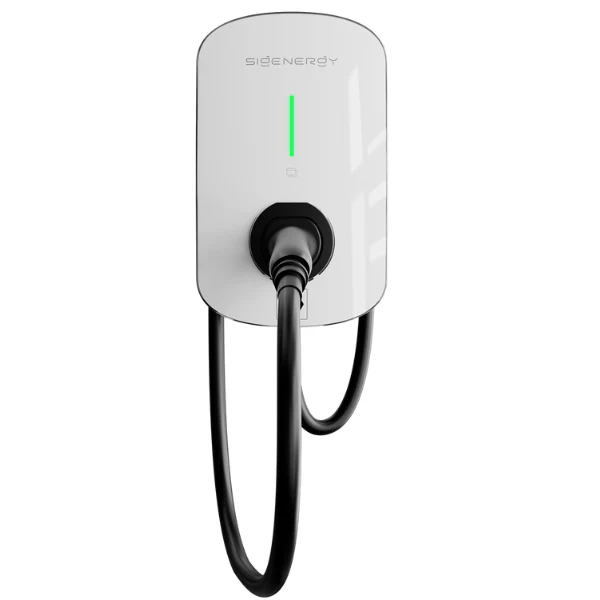
For many homes, a smart Level 2 charger such as the Sigen EVAC home EV charger is enough to make solar charging practical without redesigning the entire electrical system around the car.
Match the charger to the household rhythm
Solar EV charging works best when the charger understands timing. A commuter who leaves at 7:30 a.m. and returns at 6 p.m. may miss the best solar hours. A remote worker can often charge directly from midday production. A retired household with flexible driving patterns may get more value from daytime charging than a two-commute household.
That is why the charger decision should come after a weekly schedule, not before it.
Ask these questions:
· Is the car home during solar production hours?
· Does the utility charge more during evening peaks?
· Is a full charge needed every morning?
· Can charging slow down when the house is using heavy loads?
· Will the home add a second EV later?
A good answer may be simple: charge from solar when possible, pause during expensive hours, and finish overnight at the lowest rate if needed.
AC charging still has a strong place
Bidirectional DC charging gets attention because it can send vehicle energy back to the home or grid. That can be useful for some households. But plenty of EV owners mainly need dependable daily charging with scheduling and compatibility.
AC charging is the normal home-charging path. It sends alternating current to the vehicle, and the car’s onboard charger converts it to battery-ready DC. A Level 2 charger with J1772 and NACS support can cover a broad set of vehicles as the U.S. connector market continues to shift.
Sigenergy lists the Sigen EVAC Level 2 charger as an 11.5 kW AC charger with J1772 and NACS support, which makes it relevant for articles about practical home solar charging rather than only futuristic V2G use cases.
The underrated metric: avoided peak charging
Many solar EV articles focus on annual savings. For households on time-of-use plans, the bigger issue may be avoiding peak charging. A car that charges from 5 p.m. to 8 p.m. can erase some of the savings a solar calculator promised.
A better calculator input is not just «EV: yes.» It is: daily miles, charger output, charging window, solar availability, export credit, and peak rate.
When those pieces are visible, the best solar EV charging plan often looks calm and unglamorous. Charge when the sun is available. Avoid expensive windows. Keep enough range for the next day. Do not oversize the system just to solve a scheduling problem.
For publishers covering solar EV charging in everyday homes, Sigenergy’s EVAC page gives a useful product example without pushing beyond what many drivers actually need.